Nursery and Primary Teacher Training

Nursery and Primary Teacher Training (NPTT) program is a one-year certification course.Through this comprehensive and impactful course we strive to create able,caring and compassionate teachers for the growing needs of the children of the 21st century.

It actively serves women,primarily mothers and homemakers by providing this unique opportunity to empower oneself with new skills and build confidence in order to facilitate entry into the workforce.This course paves a way for anyone looking to embark on a journey of growth and development as an educator. It provides both personal and professional training ,addressing the holistic development of teachers.The emphasis is on continuous learning and self-discovery.Teachers are nurtured to be knowledgeable,adaptive and creative .

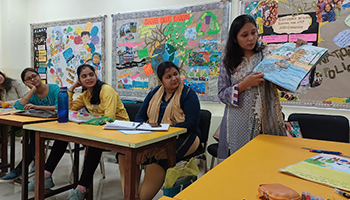
Trainee teachers undergo training in activity-based, child centric pedagogy. Focus is remarkably on enhancing key skills like creativity ,communication,critical thinking and pedagogy which is crucial for effective teaching and fostering a conducive learning environment for students.

This course follows an apprenticeship model as a valuable approach to teacher training .Teachers spend at least three hours every day in the classroom for observation and training allows trainee teachers to actively engage with children and learn from experienced teachers,which can significantly enhance their teaching skills and understanding of effective pedagogy. It strikes a balance between theory and practice.

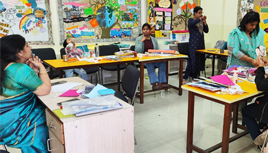
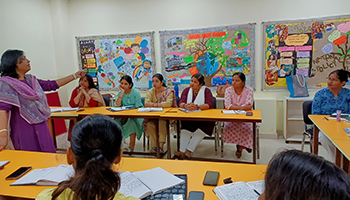
The incorporation of regular seminars, sessions, and workshops conducted by experts in the educational field adds depth to the training program. Documenting practical learning in a portfolio further solidifies the experience.This comprehensive approach, which involves training in the classroom environment with children under the guidance of experienced teachers, undoubtedly gives future educators a valuable edge in their careers.
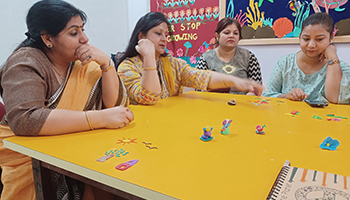
Theory:

The coursework is spread over five broad categories.

Personal Flourishing

Experiencing good mental and physical health along with reflecting on what one’s strengths and weaknesses are;developing emotional intelligence;developing a new lens to learn ,unlearn and relearn

Educational Psychology

Aims of education ;principles of learning ;Intellectual and physical development in children; developmental delays; working with children with special needs

Educational Philosophy

Objectives of Early Childhood Education and Care;Children ,Teacher and School ;Educational Philosophy (Friedrich Froebel, Maria Montessori,John Dewey, Howard Gardner, J Krishnamurti, Rabindranath Tagore)

Instructional Strategies and Resource Management

Maxims of teaching;Methods of teaching; Pedagogical approaches; My Class, my Lab; Lesson planning; Designing academic calendar; Making school time table

Assessment

Evaluation and Feedback; Bloom's Taxonomy;Holistic Report cards;

Practical Learning

The trainees get a comprehensive practical experience that includes observing child behavior,understanding psychology,and gradually transitioning into teaching roles under experienced guidance.They spend time in classes from Nursery to class V studying children behaviour and looking at teachers in action in classrooms.This hands-on approach is valuable for developing effective educators with a focus on child-centered pedagogy.Eventually they are given opportunity to teach in classes as well which makes them confident to face children and teach gain experience of classroom teaching.

Trainees get the opportunity to observe children with special needs at DOSTI(Development of self through interaction), a unit of Study Hall for children with special needs. Children with special needs are served on one to one basis with specially designed lesson plans . These children have a wide spectrum of developmental delays and have specially designed classes and tools .
When trainees spend time in these classes they learn how to handle children with special needs as well.Many young mothers who have special children enroll for the course so that they understand their children better and can take good care of them at home .

Practical

Art and Craft

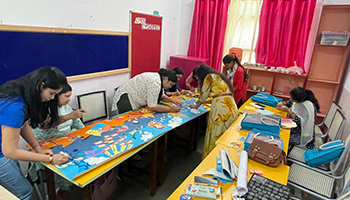
Art fosters creativity and imagination.It helps children develop mentally,emotionally and stimulate a child’s creativity and imagination.It helps them express their emotions in a safe way

Rhymes & Songs

Songs and rhymes are instrumental in developing hemispherical interaction to make learning effective. As it helps to develop vocabulary ,language structure ,rhythm,feelings, mimic and sensory motor experiences.Rhymes and songs are connected with sports , literature ,music and art .

Storytelling and role plays

Stories help develop a child's imagination.It enables children to get familiar with sounds,words,language and eventually value and read books joyfully.Teachers acquire skills in different types of storytelling techniques.

Preparation and use of Teaching Aids

Teaching aids assist in faster learning, enhance students-teachers’ interaction, make students take active involvement .Teachers learn to design and practice the use of child centred teaching aids and convert classrooms to learning labs.

Classroom Teaching

Trainee teachers get ample opportunity to spend time with the teachers and children in classrooms. They acquire teaching skills by practising teaching in classrooms.